




Knowing how to deal with a losing streak in trading is not just a skill—it’s a critical survival mechanism. Every trader, from a rookie using an online forex broker to a seasoned professional on Wall Street, faces a string of losses. It’s an inevitable part of the game. The key is responding, not reacting. This article provides a comprehensive guide to breaking the cycle. We will cover the essential emergency steps to protect your capital, deep-dive analysis techniques to diagnose the problem, psychological strategies to rebuild your confidence, and tactical adjustments to get you back to profitability.
Key Takeaways
- Stop Trading Immediately: The first and most crucial step is to take a break. This prevents further financial and psychological damage.
- Analyze, Don’t Assume: Conduct a thorough review of your recent trades using a trading journal to distinguish between strategy flaws and execution errors.
- Reduce Position Size: When you return to trading, drastically cut your trade size to minimize risk and rebuild confidence with small, manageable wins.
- Focus on A+ Setups: Be highly selective. Only take trades that perfectly match your proven, backtested strategy criteria.
- Manage Your Psychology: Acknowledge the emotional impact of losses. Use techniques like mindfulness and journaling to regain a neutral, disciplined mindset.
- Backtest and Verify: Re-evaluate your strategy against historical data to confirm if the losing streak was within expected statistical parameters or if the market regime has shifted.
Quick Answer: What to Do Right Now

When you’re in the middle of a drawdown, you need an emergency plan. Knowing how to handle losing streak in trading starts with immediate, decisive action to stop the bleeding. Here are the first-response steps every trader should take.
- Cease All Trading Activity: Your number one priority is capital preservation. Stop placing new trades. Close your platform. Walk away. This creates a crucial circuit breaker, preventing emotional decisions like revenge trading.
- Enforce Your Pre-Set Loss Limit: Every serious trader has a maximum drawdown rule (daily, weekly, or monthly). If you’ve hit it, the decision is already made for you. Honor your plan without question.
- Analyze Your Last 10 Trades: Objectively review your most recent losses. Were they due to poor execution (breaking your rules) or a potential issue with your strategy? This initial diagnosis is key. This is one of the most effective strategies for overcoming losing streaks in trading.
- Reduce Your Risk by 50-75%: When you do decide to trade again, cut your position size dramatically. Your goal is no longer to hit home runs but to regain your rhythm and confidence with minimal risk.
Read More: How to deal with trading losses
Understanding Losing Streaks in Trading
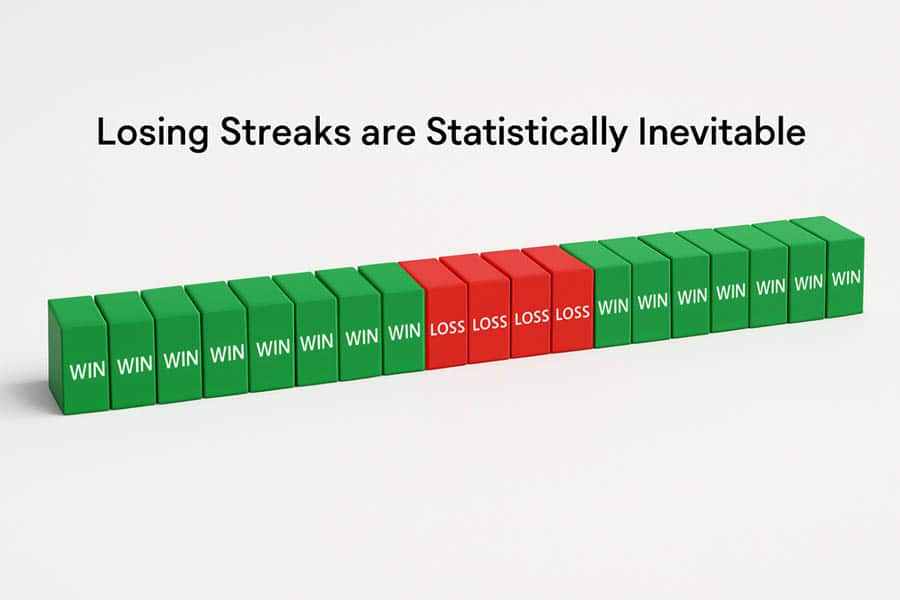
A losing streak is a series of consecutive losing trades that leads to a drawdown in your trading account. It’s a universal experience, yet it feels deeply personal and isolating when it happens. To understand how to deal with a losing streak in trading, you must first accept its normality. Even a strategy with a 60% win rate has a statistical probability of experiencing 5, 7, or even 10 losses in a row. It’s not a matter of ‘if’, but ‘when’.
Losing streaks stem from two primary sources:
- Statistical Inevitability: Random distribution of wins and losses means that clusters of losses are guaranteed to occur over a large sample of trades. Your backtesting should give you an idea of the maximum expected losing streak for your system.
- Behavioral Spirals: This is where a statistical streak gets amplified by human emotion. A few losses lead to fear, which causes hesitant execution. This leads to more losses, which can trigger frustration and revenge trading—a destructive cycle that can wreck an account far more quickly than a simple statistical drawdown. For prop traders, this behavioral breakdown is often the primary reason for failing challenges.
A real-world example is a trend-following strategy that performs exceptionally well in trending markets. During a sudden shift to a choppy, range-bound market, the strategy will inherently suffer a series of losses. The proficient trader understands this is part of the system’s nature and knows how to deal with a losing streak in trading by waiting for favorable conditions to return. The novice trader, however, may panic, question the valid strategy, and start making impulsive changes, turning a normal drawdown into a disaster.
Immediate Steps: Your Trading Emergency Plan

When the red ink starts flowing, you need a pre-defined emergency plan. This isn’t something you create in the heat of the moment; it’s a set of rules you establish when you are calm and objective. This plan is the bedrock of learning how to recover from losing streak in trading effectively.
Stop Trading and Protect Capital
The most important action is to stop. Continuing to trade during a significant losing streak is like trying to navigate a minefield while blindfolded. Your judgment is clouded, your emotional state is compromised, and the market is not going to give you your money back out of pity. A pause, whether for a day, a week, or even a month, achieves two critical goals: it protects your remaining capital from further emotional decisions and gives you the mental space needed to reset your psychology. This is the cornerstone of professional risk management and a non-negotiable step for anyone serious about trading for a living.
Set an Objective Loss Threshold
You must have a hard stop. This is a rule-based limit that dictates when you must cease trading for a specific period. It is not a suggestion. It could be:
- A Daily Loss Limit: “I will stop trading for the day if my account is down 2%.”
- A Weekly Drawdown Limit: “I will stop trading for the week if my account has drawn down 5% from its peak.”
- A Consecutive Loss Limit: “I will take a 24-hour break after 4 consecutive losing trades, regardless of size.”
Proprietary trading firms enforce these rules strictly because they know that the largest losses almost always follow a series of smaller, unmanaged ones. Adopting this discipline yourself is a vital component of knowing how to handle losing streak in trading.
Prevent the Revenge Trading Cycle
Revenge trading is the emotionally-fueled desire to “get back” at the market and win back your recent losses immediately. It’s characterized by taking oversized positions, entering trades that don’t fit your plan, and abandoning all risk management principles. It is the single most destructive force in trading. To break the cycle, you must first identify its warning signs: feeling angry at the market, thinking “I just need one big win,” or immediately re-entering a trade after being stopped out. The moment you recognize these feelings, your emergency plan must kick in: shut down the platform and walk away. The urge will pass, but the damage it can cause is permanent.
Read More: What Is Revenge Trading?
Deep-Dive: Analyze and Diagnose Your Losses

Once you’ve stepped away from the screens and your emotions have settled, the real work begins. You must transform from a trader into a detective. The goal is to objectively diagnose the root cause of your losses. This analytical process is fundamental to developing effective strategies for overcoming losing streaks in trading.
Review Your Last 10-20 Trades
Your trading journal is your most valuable tool here. Don’t just look at the profit and loss; dissect each of the last 10-20 trades with a critical eye. For each trade, ask:
- Entry/Exit Rationale: What was the original reason for taking this trade? Did it align perfectly with my trading plan’s criteria?
- Adherence to Plan: Did I follow my rules for entry, stop-loss placement, and trade management exactly as written? Or did I bend them?
- Trade Context: What was the broader market environment? Was it trending or ranging? Was volatility high or low? Was there a major news event?
- Risk Management: Did I use my standard position size? Did I move my stop-loss or fail to take profit at a designated target?
Distinguish Strategy Error vs. Execution Error
This is the most critical distinction you must make. Your analysis will lead you to one of two conclusions:
- Execution Error: You have a proven, profitable strategy, but you failed to follow its rules. You were impatient, fearful, greedy, or undisciplined. The losses came from *you*, not the system. This is the most common reason for a losing streak.
- Strategy Error: You followed your rules perfectly, but the strategy itself is no longer effective in the current market conditions. The market environment has changed, and your edge has diminished or disappeared.
The solution for an execution error is to work on your discipline and psychology. The solution for a strategy error is to review and potentially adapt your system. Confusing the two is a catastrophic mistake. Many traders incorrectly change a winning strategy because they couldn’t execute it with discipline.
Compare Against Your Backtested Data
A robust trading strategy should be thoroughly backtested. This data provides a crucial baseline for performance, including the maximum expected drawdown and the longest historical losing streak. Now, compare your current streak to this data. Is a streak of 8 losses within the expected parameters of your system’s backtest? If so, it’s a statistical drawdown. You need to persevere. However, if your backtest shows a maximum historical losing streak of 6 trades and you’ve just had 12, it’s a red flag that something more fundamental has changed. This data-driven approach removes emotion and provides an objective answer to the question, “Is this normal?” It is a mature way to approach the problem of how to deal with a losing streak in trading.
Strategy Review: When and How to Adjust

After a thorough analysis, you may conclude that the market has changed and your strategy needs a tune-up. This is a delicate process. Over-optimizing a strategy based on a short-term losing streak is a common mistake. Here’s how to approach adjustments methodically, a key skill for traders looking for long-term success.
How Market Conditions Affect Performance
No single strategy works in all market conditions. A trend-following system will struggle in a sideways, choppy market. A mean-reversion strategy will get crushed during a strong, persistent trend. A low-volatility breakout strategy will fail when volatility spikes. Your first job is to identify the current market “regime.” Has the market shifted from trending to ranging? Has volatility contracted or expanded significantly? Understanding this context is crucial before making any changes. The ability to correctly identify these shifts is a hallmark of traders who know how to deal with a losing streak in trading.
When to Stick vs. When to Modify
Here’s a simple framework:
- Stick to Your Plan If: Your analysis showed the losses were due to execution errors, or the losing streak is within the statistical expectations of your backtested results. The problem isn’t the plan; it’s your discipline. The solution is to focus on flawless execution.
- Consider Modifying If: You have followed your plan perfectly, yet the losing streak exceeds historical norms, AND you can identify a clear shift in market behavior that invalidates your strategy’s core premise.
Modification doesn’t mean throwing the whole strategy away. It might involve adding a market regime filter (e.g., “I will not take trend-following trades if the ADX indicator is below 20”), adjusting stop-loss parameters to account for increased volatility, or focusing only on the highest-probability setups.
Demo Trade to Test and Rebuild Confidence
Never test a new strategy or a modification with real money. Return to a demo or paper trading account. This provides a zero-risk environment to validate your adjustments. More importantly, it helps you rebuild your psychological capital. Stringing together a series of small, successful trades—even in a demo account—can do wonders for your confidence. It helps you get your rhythm back and proves that you can still execute a plan flawlessly. This is an essential step in the process of learning how to recover from losing streak in trading and should not be skipped.
Tactical Recovery Moves

Once your analysis is complete and you’re ready to ease back into the market, you need to be deliberate and cautious. This phase is about survival and confidence-building, not aggressive profit-seeking. These tactical moves are your practical toolkit for navigating the recovery.
Trade Smaller (Reduce Position Size)
This is the most important tactical adjustment. Cut your position size to 50%, 25%, or even 10% of your normal size. The goal is to make the monetary outcome of the next few trades almost irrelevant. This accomplishes several things: it drastically reduces the financial risk if the streak continues, it lowers the emotional pressure on each trade, and it allows you to focus purely on the process of good execution. Seeing a small win is infinitely better for your psychology than risking too much and suffering another large loss.
Focus Only on “A+” Setups
During a recovery phase, you must be ruthlessly selective. Do not take “okay” or “pretty good” trade setups. Wait for the “A+” opportunities—the ones that align perfectly with every rule in your trading plan. This forces patience and discipline, which are the very skills that may have eroded during the losing streak. By focusing only on the best, you increase your probability of success and reinforce good trading habits. This is a core principle in many strategies for overcoming losing streaks in trading.
Adjust to Market Conditions
Consider a temporary change in your trading environment to reduce risk. This could mean:
- Trading Higher Timeframes: Move from a 5-minute chart to a 1-hour or 4-hour chart. Higher timeframes are generally less noisy and require fewer decisions, which can be calming.
- Trading Lower-Volatility Markets: If you trade volatile instruments like certain crypto pairs or indices, consider switching temporarily to more stable major forex pairs.
Tighten Your Risk Parameters
Implement a hard, non-negotiable maximum loss limit for the trading session. For example, “I will stop trading for the day after two losing trades OR if I am down 1%.” This acts as a safety net, ensuring that one bad day doesn’t spiral out of control. It’s a crucial discipline that reinforces the idea that capital preservation is your top priority during a recovery. Knowing how to deal with a losing streak in trading is synonymous with knowing how to tighten your defenses when you are vulnerable.
Read More: How to Overcome Fear in Forex Trading
Risk Management Adjustments

Proper risk management is always important, but it becomes your lifeline during a drawdown. While recovering, your focus shifts from offense (making profits) to defense (protecting capital). This requires a conscious and disciplined reinforcement of your risk rules.
Set and Enforce New Recovery Limits
Your standard risk limits may need to be tightened during the recovery phase. For instance, if your normal daily stop is 3%, you might reduce it to 1.5% until you’ve had a week of consistent profitability. These are not permanent changes, but temporary guardrails designed to keep you in the game. The key is enforcement. Writing the rule down is easy; honoring it after a loss requires true discipline. This is a practical step that shows you know how to handle losing streak in trading with maturity.
Position Sizing for Capital Preservation
Your position size should always be a function of your account balance. As your account draws down, your position size must decrease accordingly. A common mistake is maintaining the same lot size after a series of losses, which means you are actually risking a larger percentage of your remaining capital. Use a fixed fractional position sizing model (e.g., risking no more than 1% of your current account equity on any single trade). This automatically scales down your risk as your account shrinks and protects you from catastrophic losses.
The Power of Consistency
The consistent application of your risk rules is what separates amateurs from professionals. A professional trader who loses 10% of their account has a bad month. An amateur who loses 10% might try to win it all back in one “hero trade” and end up losing 50%. Your risk management plan is your contract with yourself. Breaching it is the fastest way to failure. During a recovery, adhering to it with perfect consistency is your path back to stability.
Mindset, Emotions, and Psychological Recovery

A losing streak is as much a psychological battle as it is a financial one. You can have the best strategy in the world, but if your mindset is broken, you will fail. Learning how to deal with a losing streak in trading is, at its core, learning how to manage your own mind.
Normalizing the Emotions of a Drawdown
First, understand that feelings of doubt, frustration, fear, and even anger are completely normal. Every single funded prop trader has felt this way. The difference is that they have developed mechanisms to process these emotions without letting them dictate their trading decisions. They experience the emotion, acknowledge it, and then revert to their logical, rule-based plan. You are not a bad trader for feeling this way; you only become one if you act on those feelings.
Techniques for Regaining Confidence
Confidence is a byproduct of successful execution. You can’t simply will it to appear. You must rebuild it brick by brick through disciplined action:
- The Power of the Pause: As mentioned, stepping away is the first step to regaining clarity.
- Mindfulness and Meditation: These practices train your brain to observe thoughts and feelings without being controlled by them.
- Journaling for Clarity: Write down not just your trades, but your feelings about them. This externalizes the anxiety and helps you process it.
- Community Support: Talk to other traders. Sharing your experience in a trusted community can be incredibly validating and can provide new perspectives.
The Dangers of Overconfidence and Underconfidence
After a losing streak, you are vulnerable to underconfidence, which can cause you to hesitate or miss valid setups. Conversely, after a winning streak that breaks the slump, you are vulnerable to overconfidence, which can lead to recklessness and a repeat of the cycle. The goal is to cultivate a state of neutral confidence—a deep-seated belief in your edge and your ability to execute it, independent of the outcome of the last few trades.
Re-Entry: Getting Back in the Market

Knowing when and how to return to full-scale trading is the final piece of the puzzle. A premature return can undo all your hard work. A systematic, gradual re-entry is crucial for long-term survival and is a sign that you have truly learned how to recover from losing streak in trading.
Signs You’re Ready to Trade Again
Look for objective signs that you are ready, not just a feeling that you “want to trade.” These signs include:
- Consistency in Demo Trading: You have successfully executed your plan on a demo account for a set period (e.g., 10 consecutive trades without breaking a rule).
- Emotional Stability: You can review the market and your past losses without feeling an emotional charge of fear or anger.
- A Clear, Written Plan: You have your trading plan, risk limits, and recovery rules in front of you.
Gradually Scaling Back In
Do not jump back in with your full position size. Start with the small, 25% or 50% size you used for recovery. Set a goal, such as, “After I have three consecutive winning days, I will increase my size to 75%. After a full week of profitability, I will return to 100%.” This gradual scaling process protects you while you are still rebuilding and ensures that your return is based on demonstrated performance, not hope.
Monitoring Performance Closely
Your return to the market should be slow and controlled. Monitor your performance and your psychological state with extra vigilance. Continue to journal every trade and every feeling. If you find yourself slipping back into old, undisciplined habits, it is a sign that you need to step back again. The market will always be there tomorrow. Your capital might not be.
Lessons from Funded and Prop Traders
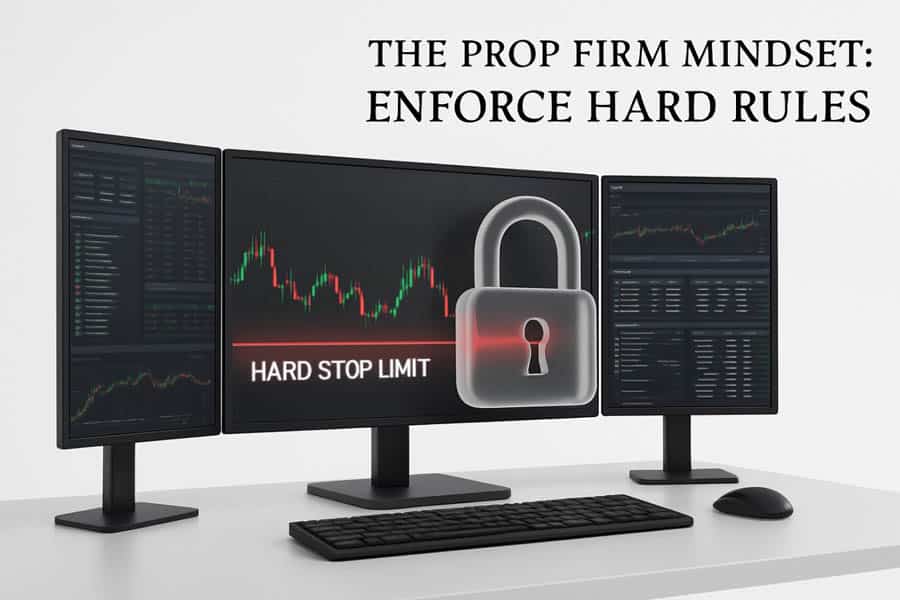
Proprietary trading firms have mastered the art of risk management because their survival depends on it. Individual traders can learn immense lessons from their models. For these firms, knowing how to deal with a losing streak in trading is not just advice; it’s a system of hard rules.
Prop firms enforce strict daily loss limits and maximum drawdown rules. If a trader hits the daily limit, their account is often automatically flattened and locked until the next trading day. If they hit the maximum drawdown, their account is closed. There is no negotiation. This strict discipline removes the emotional element of deciding when to stop. It forces traders to manage risk on every single trade because the consequences of failing to do so are immediate and severe. By adopting these same strict, non-negotiable rules for yourself, you are essentially acting as your own professional risk manager.
Advance Your Trading with Opofinance
As an ASIC-regulated broker, Opofinance provides the secure and advanced environment you need to implement professional trading strategies. Benefit from our cutting-edge tools and platforms.
- Advanced Trading Platforms: Choose from MT4, MT5, cTrader, and the intuitive OpoTrade app.
- Innovative AI Tools: Leverage our AI Market Analyzer, AI Coach, and 24/7 AI Support to sharpen your edge.
- Social & Prop Trading: Join a community of traders and explore opportunities in proprietary trading.
- Secure & Flexible Transactions: Enjoy safe, convenient deposits and withdrawals, including crypto payments with zero fees.
Start Trading with Opofinance Today
Conclusion
Learning how to deal with a losing streak in trading is a journey of discipline, analysis, and psychological resilience. It is a skill that is forged in adversity. By implementing an emergency plan, conducting objective analysis, making tactical adjustments, and managing your mindset, you can transform a devastating drawdown into your most valuable learning experience. Remember that your primary job as a trader is not to make money, but to manage risk. If you do that well, the profits will follow.
Actionable Checklist: Surviving and Thriving After a Losing Streak
- [ ] Immediately stop all live trading.
- [ ] Step away from your trading desk for at least 24 hours.
- [ ] Review your last 10-20 trades in your journal.
- [ ] Identify if losses were from execution errors or strategy flaws.
- [ ] Compare your current drawdown to your backtested historical data.
- [ ] Re-affirm your trading plan or make adjustments (test in demo).
- [ ] Begin trading again with a 50% reduced position size.
- [ ] Focus only on “A+” quality trade setups.
- [ ] Enforce a strict daily loss limit.
- [ ] Gradually increase size only after achieving consistent profitability.
Should you ever change strategy mid-streak?
No. Making strategic changes while you are emotionally compromised is a recipe for disaster. Stop trading, analyze objectively when calm, test any changes on a demo account first, and only then implement them with real money.
How many losses before you should stop trading for the day?
This should be pre-defined in your trading plan. A common rule for day traders is to stop after 3-4 consecutive losses, or once a specific monetary drawdown (e.g., 2% of the account) is hit, whichever comes first.
What if my demo trading results also decline?
This is valuable information! It strongly suggests the issue is with your strategy itself and not just your psychology, as there’s no real money pressure in demo. It’s a clear signal to re-evaluate your strategy’s edge in the current market conditions.
Is it better to take a long break or a short break?
The length of the break should match the severity of the psychological impact. A short break (1-2 days) is for a minor slump. A longer break (a week or more) is necessary if you feel burnt out, angry, or have lost significant confidence.
Can a losing streak be a good thing?
Yes, if you use it as an opportunity for growth. A losing streak exposes weaknesses in your strategy, discipline, and mental fortitude. By analyzing and correcting these weaknesses, you become a much stronger and more resilient trader.